

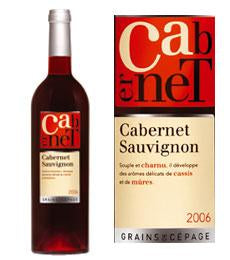

Is it Cabernet Sauvignon or cabernet sauvignon?
The New York Times and Slate.com don’t capitalize the names of grape varieties but practically everyone else does. What, then, is the correct usage?
This may seem a little geeky or pedantic but it’s important for anyone who writes about wine. I seem to revisit this question every couple of years without satisfaction.
byThis year, however, I believe I finally have the answer thanks to some online research and a series of emails with Tyler Colman AKA Dr. Vino. Since neither Tyler or I have the book, the assumption is that the New York Times Manual of Style and Usage says not to capitalize grape variety names. Thus not knowing what they base their no-caps decision on, we turned instead to Wikipedia to investigate naming conventions in botany and found some interesting things: from the Variety (Botany) page:
In viticulture, what is referred to as "grape varieties" are in reality cultivars rather than varieties according to usage in the International Code of Nomenclature for Cultivated Plants, since they are propagated by cuttings and have properties that are not stable under sexual reproduction (seed plants). However, usage of the term variety is so entrenched in viticulture that a change to cultivar is unlikely.Ok, since it’s actually a cultivar, I went to the Cultivar page to see how they’re named:
A cultivar name consists of a botanical name (of a genus, species, infraspecific taxon, interspecific hybrid or intergeneric hybrid) followed by a cultivar epithet. The cultivar epithet is capitalised and put between single quotes: preferably it should not be italicized. Cultivar epithets published before 1 January 1959 were often given a Latin form and can be readily confused with the specific epithets in botanical names: after that date, newly coined cultivar epithets must be in a modern vernacular language to distinguish them from botanical epithets. Cryptomeria japonica 'Elegans' Chamaecyparis lawsoniana 'Aureomarginata' (pre-1959 name, Latin in form) Chamaecyparis lawsoniana 'Golden Wonder' (post-1959 name, English language) Pinus densiflora 'Akebono' (post-1959 name, Japanese language)
The technically correct nomenclature for a grape variety would then be: Vitis vinifera ‘Cabernet Sauvignon’.
It would be unnecessarily pedantic to include Vitis vinifera each time we write about grape varieties so what then is the proper way to condense the name? Should they be capitalized or not?
Based on this research, I’m going to continue to capitalize grape varieties. If it’s good enough for Jancis Robinson, Hugh Johnson, Robert Parker, Maynard Amerine and Emile Peynaud, it’s good enough for me. Tyler (a die hard New Yorker), however, isn't swayed by this evidence and will continue to not capitalize grape names along with the Times.
What do you think? Cabernet Sauvignon or cabernet sauvignon?


Comments
safer to Meet Here Than In Bars Or Pubs
online dating sites present the best opportunity for singles to meet online in a modern way that is both convenient and time saving. There are several positive aspects to be gained over meeting singles online. Firstly, Emailing a new dating friend doesn’t require the same instant confidence required when trying to chat with someone new in a bar or pub. Emailing can also give you time to consider your words carefully and put more thought into your communicating.
Bar atmospheres can exhibit as sleazy and noisy. It is not the best environment in an effort to initiate a good conversation with someone new. not to say that alcohol is a typical factor which can steer a person mentally away from their true intentions and can give a false sense of confidence. Alcohol can be a significant factor in determining the prosperity of a new couple or not. Look at how often fights break out in discos over women, illegal drugs, Drinks and other stuff and usually it sparks out of jealousy, false impression or misjudgement.
The advantages of online dating services to meet someone are many. Firstly, You don’t have to look the best during your encounters web-sites because is asiame legit you won’t be visible until you start a video online chat room conversation with them. Second, The online dating sites allow you time to carefully plan what you want to say to somebody before making your move which could potentially very nerve racking for some people. in a bar or pub, You have only really about five minutes to capture someone’s attention properly and give them the chance to assess if they want to continue conversation with you. You must get the best attention from your ex instantly in a bar or pub, Otherwise your time and effort will be quickly thwarted. The internet offers true flexibility with online transmission. Fourth, You can share all the information you like with someone over a longer period of time, fluids, for instance pictures, programs, short clips and blogs. This will convey your nature and impress on others your creative ability. Also video chat and one on one chat captures the essence of true online dating sites.
However the experience of dating is received online, They will always be an enjoyable and exciting facility to meet a special someone. online dating services are typically the best way to control your communication with someone without the immediate pressures of deciding whether you click or not.
Zone54 online dating site was created to help Australians unite quickly and easily with our unique video chat rooms and sms text email service. We also recognise the needy in these times by giving a portion of site revenue to Worldvision Australia.
The NYT 5 rules: https://www.nytimes.com/1985/08/25/magazine/on-language-wines-without-caps.html
Forgive this belated response, but I was as puzzled as everyone else about capitalization of wine grapes and found this blog post through an internet search. I am both a writer and an ardent follower of the Associated Press Stylebook, so looked up wine varietals there. Like The New York Times, AP also does not capitalize wine grapes. Never mind this well-researched post (love the background about varietals vs. cultivars), who am I to argue with Jancis Robinson, Hugh Johnson, Robert Parker, Maynard Amerine and Emile Peynaud? I am taking the wine enthusiast approach like so many of you. Cabernet Sauvignon, Chardonnay, Zinfandel and Pinot Noir it is!
If I remember correctly, if an adjective is a word that also describes the name of a race or nation of people, then the adjective is capitalized. So if a varietal name describes a county where the people who live in that county capitalize it, does it carry that same prestige to its other modify-ees? (groan) An English saddle is never lower case. English is never lower case. Dutch is never lower case. Using that authority, is Champagne ever lower case? Is Napa ever lower case? The names of grapes are always regions that are basically rural population centers, aren’t they? Has this already been addressed in this thread, or is it even relevant? I don’t know that much about wine.
Thanks all for this discussion. At least, now, I won’t be vexed when I see grape varieties capitalized. However, I still prefer to see them in small case. It is more consistent with the English Language where only names are capitalized (never seen a genus capitalized.) A grape variety is much more like a type of something than a name. We don’t capitalize types.
Hi Jo,
Thanks for the note. This post was written in 2008, so the NYT may have changed their ways.
Curious – what are the 5 rules that you speak of?
You have mis-characterized the NYT policy. There are five rules. Sometimes the NYT does capitalize names of grapes.
Correction: I like your thought process and am going with capitalizing all of them.
Thank you, Ellen Wallace! I have to plead my ignorance of wine varieties, varietals…or anything more than, “I like this one because it tastes sweet.” (I can already see readers’ eyes rolling in horror…) However, I am editing a book that lists many varieties of wine. I want to be as grammatically and stylishly correct as possible, but I’ve read so many conflicting opinions. I like your thought process, and am going with capitalizing all of them.
Steve, I love that you answer my questions without having to even ask them.
I was getting ready to accept that the capitalization I employed on my site was terribly wrong-headed — I actually suspected lower case was “more” correct. Yet here you produce an interesting thread. But, like when drinking wine, you cannot always explain what you feel so I will continue to put caps my varieties because, I dunno, it just feels good somehow… no matter the prevailing theory on etymology or accepted style (hope that doesn’t make me sound like an ignoramus).
Sir, next question: Can wine ignoramuses be considered of the same breed as wine idiot savants? I need to know. Thanks